
Types of barrier and elements
Rail barrier without cross rail
The basic pedestrian guardrail, 150 and 200 cm.
Rail barrier with one cross rail
The common variant along walkways.
Rail barrier with two cross rails
Higher rigidity and better visibility of the enclosure.
Regional rail pattern
A regional variant of the guardrail used in many cities.
Infill barrier with vertical bars
Close-spaced bars, chosen near schools and along walkways.
Infill barrier with two runs
The version with additional horizontal runs.
Chain barrier
Posts with chain, a light way to close off walkways and car parks.
Anti-splash pavement barrier
Fitted with a screen limiting spray from the carriageway.
Tram barriers
Enclosing track beds and platforms in urban traffic.
Flexible barriers
Polymer units that return to shape after impact.
Road separators
Separating directions of travel and marking out lanes.
Anti-glare screens
Limiting headlight glare on dual carriageways.
Speed cushions
Traffic calming on internal and residential roads.
Edge marker posts
Marking the carriageway edge and clearance on rural sections.
Road barriers: types, dimensions and fixing
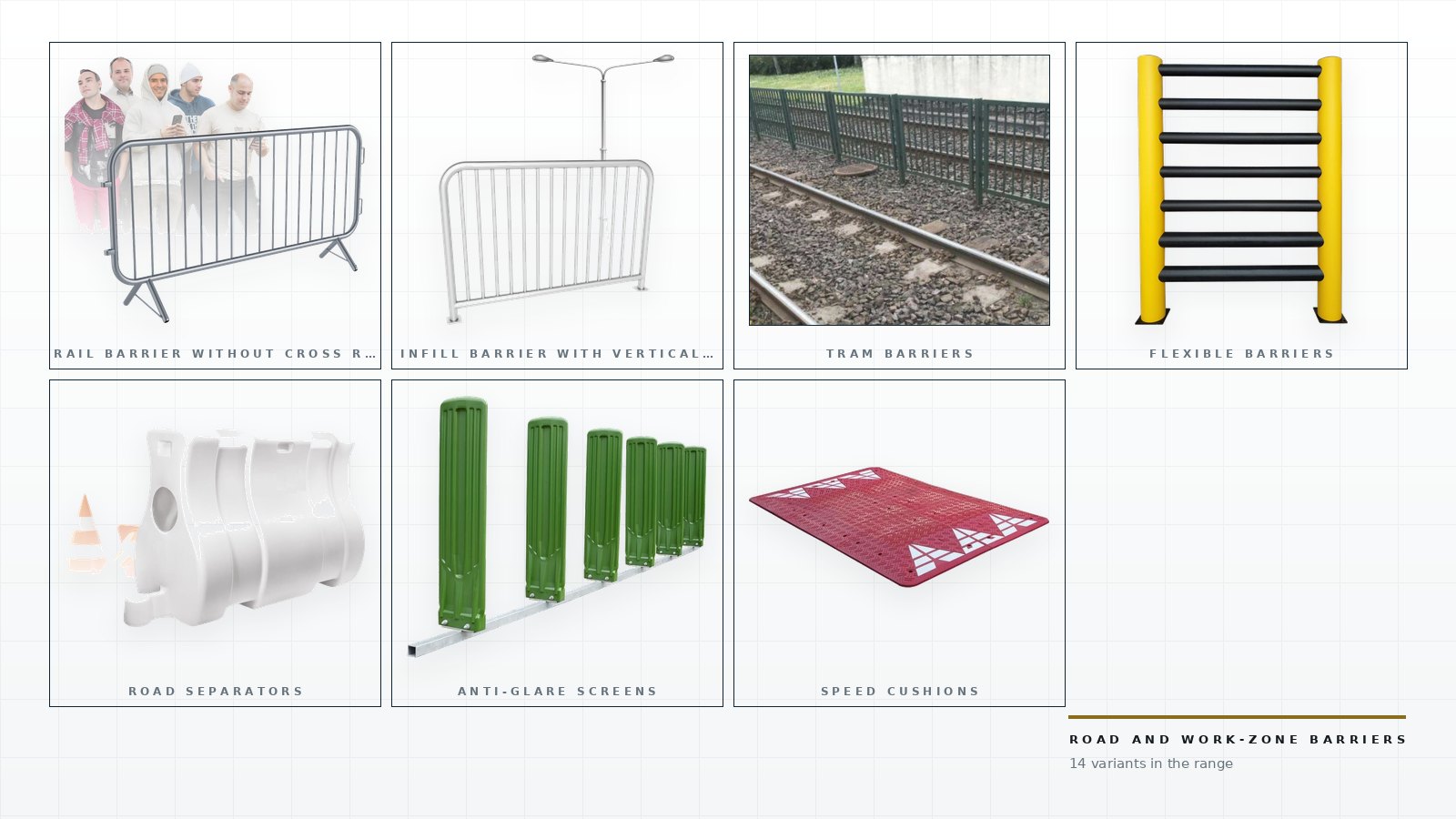
Protective barriers within the road reserve follow the types required by the road authority. The rail type comes without a rail, with one rail and with two rails; the infill type uses close-spaced bars; the chain type uses posts and chain. Typical sizes are 150 and 200 cm long at 110 cm high, with tube diameters around 60.3 and 48.3 mm.
The category covers rail barriers in all variants including regional patterns, infill barriers with one or two runs, chain barriers, anti-splash pavement barriers, tram barriers, flexible polymer barriers, splash barriers, road separators, anti-glare screens, speed cushions and edge marker posts.
The fixing method and the location decide the choice. Concreted versions are used for permanent schemes; bolted versions and movable bases suit temporary works and layouts that change. Finishes include hot-dip galvanizing, powder coating in signal colours and reflective elements.
Products in this category
Where it works
What the quotation confirms
Frequently asked questions
Do the barriers carry the required approvals?
Concreted or bolted?
What is the difference between the infill and rail types?
We will match barriers to the traffic plan for your section.
Send the run length, site conditions and deadline, and we will come back with a configuration and a quotation.