Panels, accessories and entries in the system
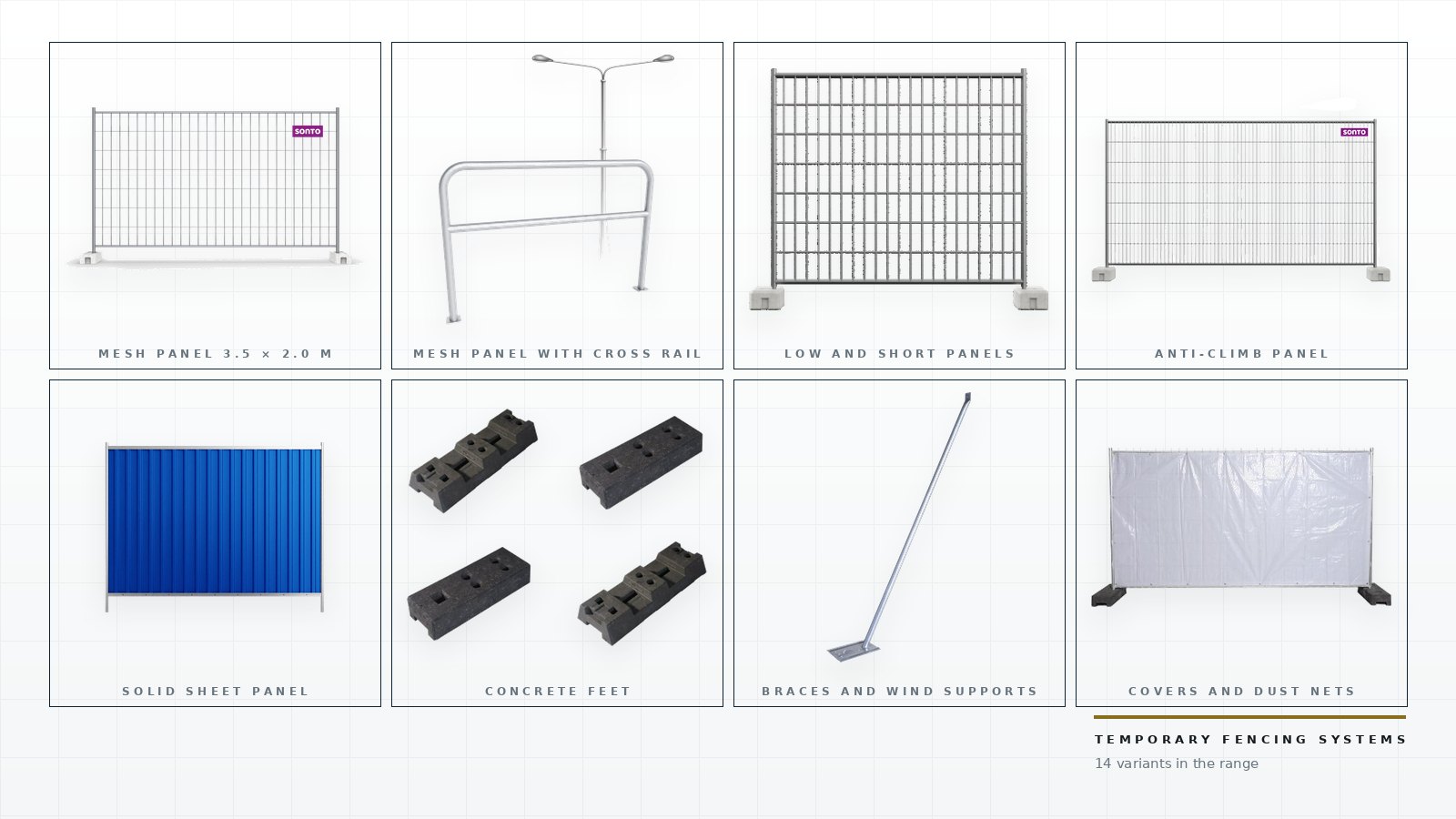
Mesh panel 3.5 × 2.0 m
The construction-site standard: welded mesh in a frame, set on feet without groundworks.
Mesh panel with cross rail
Reinforced with a horizontal profile for runs exposed to wind and load.
Low and short panels
Infill sections at slopes, entrances and narrow passages.
Corner panel
A ready-made change of direction without cutting panels.
Anti-climb panel
Tighter mesh that hinders climbing on higher-risk stretches.
Solid sheet panel
Trapezoidal sheet that closes the view and limits noise and dust.
Half-solid panel
Solid lower section, mesh above: screening without closing the view entirely.
Concrete feet
The base for panels on made-up and unmade ground.
Plastic (PVC) feet
Lighter to transport, filled on site, for repositioning during the works.
Couplers and clamps
Joining panels, with anti-tamper versions for theft-exposed zones.
Braces and wind supports
Stabilising runs exposed to wind and horizontal loads.
Covers and dust nets
Limiting dust, sparks and visibility along the enclosure.
Sliding and swing gates
An entry in the fence line sized for site vehicle traffic.
Doors and gate-leaf doors
Pedestrian entry away from vehicle routes or built into the gate.
Temporary construction fencing: what the category covers
Temporary fencing is a system, not a single product. It consists of panels, feet, couplers and entry points, and the configuration follows from the run length, the ground, wind exposure and the requirements for visibility and noise. A typical mesh panel measures 3.5 × 2.0 m with welded mesh in a hollow-section frame; the solid version uses trapezoidal sheet on the same frame.
The category covers mesh panels in standard, low, short and corner versions, anti-climb panels with a tighter mesh, solid and half-solid panels, concrete feet and fillable plastic feet, couplers and anti-tamper clamps, braces for wind-exposed runs, covers and dust nets, plus sliding and swing gates and pedestrian doors set into the fence line.
Selection turns mainly on the perimeter length, the number and width of entries, the ground under the feet and whether the run has to stay see-through. In built-up areas and on exposed runs, braces are added and the covered area is limited. Temporary fencing is available for purchase and for hire, with installation agreed per project.
Products in this category
Where it works
What the quotation confirms
Frequently asked questions
How many panels does my site need?
Can the fence be moved as the build progresses?
Hire or purchase?
We will price the fencing for your site.
Send the run length, site conditions and deadline, and we will come back with a configuration and a quotation.